
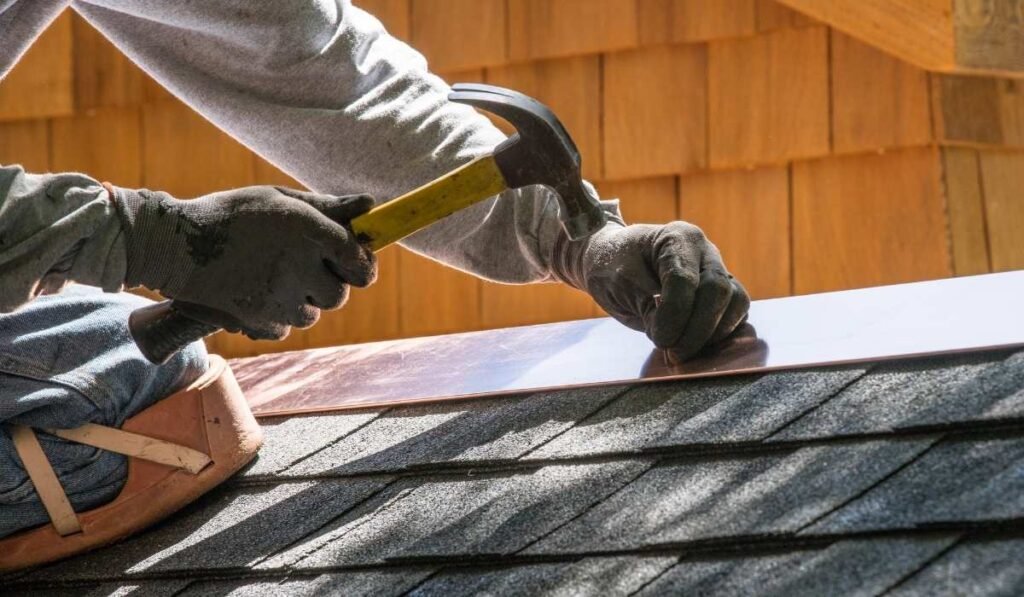
A homeowner on Springmill Street in Mansfield called a roofing contractor on a Tuesday afternoon in January 2024. She had noticed a small water stain on her living room ceiling after a heavy rain the previous Friday. It was the size of a dinner plate. Not dramatic. Not urgent looking. She figured she would deal with it in spring when the weather improved.
By Sunday, the stain had grown to roughly three feet across. By the following Wednesday, a section of the ceiling drywall had noticeably sagged when she pressed on it. By the time the roofing contractor arrived Thursday morning, there was standing water trapped between the ceiling drywall and the insulation above it, the decking in a four-foot section near the chimney was saturated and beginning to delaminate, and the repair cost had climbed from what would have been an $800 flashing repair to a $6,400 decking and interior restoration project.
Nine days. An $800 problem became a $6,400 problem because a dinner-plate water stain looked manageable.
Here is the reality about roof damage that most roofing guides avoid saying directly: some roof problems can genuinely wait for scheduled repairs. A few missing granules cannot. Black algae streaks need treatment, but not today. But a distinct category of roof damage conditions is a genuine emergencies that worsen on an accelerating curve with every hour you delay action.
This guide identifies the five signs that place your roof in the emergency category and tells you exactly what to do about each one.
What Makes Roof Damage an Emergency Versus a Scheduled Repair?
Emergency roof damage shares three characteristics. First, active or imminent water intrusion into the building envelope. Second, a structural compromise that puts the roof assembly at risk of progressive failure. Third, conditions that worsen at an accelerating rate rather than a linear one.
That third characteristic is the one most homeowners underestimate. Roof damage does not degrade at a steady pace. A small breach that admits water into the decking creates a wet environment that draws more water through capillary action, which saturates the substrate faster, which increases the weight loading on the affected area, which accelerates structural degradation, which widens the breach further. The damage curve is exponential once active water intrusion begins, not linear.
In Ohio’s climate, this acceleration is amplified. A wet roof section in January is subject to freeze-thaw cycling that expands and contracts the saturated wood fibres daily, dramatically accelerating delamination and structural weakening. A roof breach in August creates ideal conditions for mould colonisation in insulation within 24 to 48 hours of initial saturation.
Sign 1: Active Water Dripping or Pooling Inside the Home
Active water entry is the clearest emergency indicator. If you can see, hear, or measure water coming through your ceiling or down your walls during or after a rain event, every hour of delay multiplies the damage.
Here is what nobody tells you about active roof leaks: the entry point at the ceiling is almost never directly below the breach in the roof. Water enters the building envelope at the breach, travels along the roof deck, flows along a rafter or truss, and drips from the lowest point it reaches. A ceiling stain in the centre of a room may trace back to a flashing failure at a chimney twenty feet away. This means the damage path between the actual breach and the visible symptom may be saturating insulation, framing, and drywall across a wide area that you cannot see from below.
Place buckets to catch dripping water to limit interior damage, but understand that this is not a solution. It is damage containment while you arrange emergency repair.
Document everything with photos and video before any cleanup begins. Insurance claims for water intrusion require documentation of the damage as found, and thorough documentation from day one consistently produces better claim outcomes.
The secondary damage clock starts immediately. Water in insulation creates conditions for mould growth within 24 to 48 hours in Ohio’s summer temperatures. Saturated drywall begins to lose structural integrity within hours of initial wetting. In winter, water trapped in the ceiling assembly freezes overnight and expands the affected area with each freeze cycle.
Emergency tarping by a licensed Mansfield roofing contractor stops the water entry while permanent repair is arranged. Standard emergency tarp installation in Mansfield runs $300 to $600, depending on roof pitch, tarp area, and accessibility. This cost is almost always covered under your homeowner’s insurance policy as an emergency mitigation expense.
Sign 2: Ceiling or Roof Deck Visibly Sagging
A sagging ceiling is not a cosmetic concern. It is a structural warning that something above it is carrying a load it cannot handle.
Sagging ceilings result from one of three conditions: prolonged water saturation that has weakened the drywall and the framing that supports it, structural damage to the roof assembly above (rafters, trusses, or decking) that is transferring load to the ceiling, or active accumulation of water weight above the ceiling membrane.
The third condition is the most dangerous and requires immediate action. A section of the ceiling holding pooled water above it is under continuous increasing load. When that ceiling lets go, it does so suddenly and completely. A four by eight foot section of wet ceiling, drywall and saturated insulation can weigh 400 to 600 pounds. Do not stand beneath a visibly bulging or heavily sagging ceiling section.
If you observe active ceiling sagging in a Mansfield home, evacuate the area beneath the sagging section immediately. Do not attempt to poke a hole in the ceiling to drain the water unless you understand exactly what is above it and are prepared for the possibility that the entire section may release. A licensed contractor can assess the situation safely.
From a roofing perspective, a visible ceiling sag from inside almost always indicates that damage to the roof deck above has progressed significantly beyond what is visible on the exterior. The Springmill Street homeowner’s $6,400 repair bill was largely the result of exactly this sequence.
Sign 3: Missing Shingles Exposing Bare Roof Deck
A missing shingle is not, by itself, an emergency. Shingles blow off occasionally, and a single missing shingle with intact underlayment below it represents a manageable scheduled repair.
Missing shingles become an emergency under two conditions: when the missing shingle area is large enough or positioned to compromise the waterproofing of the roof system, or when the underlayment below the missing shingles is also compromised or absent.
Older Mansfield homes, particularly those with roofs installed before 2000, were frequently installed without proper ice and water shield at the eaves and may have been installed with felt underlayment that has since deteriorated or torn. When shingles blow off these roofs during Ohio wind events, the protection below may be minimal or absent, leaving the actual wood decking exposed to the weather.
Exposed roof decking is an emergency in Ohio’s climate at any time of year. In winter, bare wood decking exposed to precipitation absorbs moisture, begins to deteriorate rapidly through Ohio’s freeze-thaw cycling, and creates the wet-decking conditions that lead to structural failure. In summer, exposed decking absorbs UV radiation and moisture simultaneously, accelerating degradation and creating conditions for biological growth that penetrates the wood substrate.
After any significant Richland County wind event (gusts above 45 mph are common in spring and fall storm seasons), a visual inspection from the ground to identify missing shingles is worthwhile. An emergency tarp installation or temporary shingle replacement protects the exposed area while permanent repair is arranged, typically at a cost of $300 to $800.
Sign 4: Interior Mould Appearing Near Roof Penetrations or Eaves
Mould on interior ceiling surfaces near exterior walls, chimneys, skylights, or attic hatches is a sign that moisture has been entering the building envelope long enough to support biological growth. This is not a new problem. It is a slow problem that has been developing and has now reached a visible stage.
Here is the uncomfortable truth about interior mould near roof penetrations: by the time mould is visible on a finished ceiling surface, the mould colony in the building materials behind and above that surface is significantly larger and more established. Mould visible on painted drywall typically indicates months of prior moisture infiltration. The visible surface growth is the end of a long process, not the beginning.
This matters for repair sequencing. Addressing only the cosmetic mold on the ceiling surface without identifying and correcting the roof breach that caused the moisture infiltration is the most common and expensive mistake homeowners make with associated roof damage. The mold returns within weeks because the moisture source is still active.
In Mansfield homes, growth associated with roof leaks is most commonly found in three locations: along the north eave line, where ice dam backup creates sustained moisture; around chimney penetrations, where flashing failures admit water that tracks along the chimney framing, and at skylight perimeters, where condensation and flashing gaps combine.
Emergency roof repair combined with professional mold assessment is the correct response. The mold remediation industry in Mansfield typically charges $1,200 to $4,000 for residential mold remediation depending on extent, and this cost is frequently covered under your homeowner’s insurance policy when it results from a sudden and accidental roof failure.
Sign 5: Roof Deck or Structural Framing Visible From the Attic
This sign requires access to the attic space, but any Ohio homeowner who has not inspected their attic after a significant storm event is missing the most direct diagnostic view available.
Look for three conditions in a post-storm attic inspection: daylight visible through the roof deck (indicating breach or decking failure), active moisture or frost on the underside of the decking or on framing members (indicating active infiltration or condensation), and dark staining or soft spots in the decking when carefully probed (indicating prior water intrusion or decking rot).
Daylight through the roof deck is an unambiguous emergency. Any opening large enough to admit light is large enough to admit water, and water admitted through a decking breach bypasses every layer of weather protection below it, depositing directly onto framing and insulation.
Soft or spongy spots in the roof decking, detectable by careful probing with a screwdriver from the attic, indicate decking rot that has progressed to the point where the structural integrity of the roof assembly in that area is compromised. A two-foot soft spot in January is commonly a six-foot soft spot by April if left unaddressed through Ohio’s winter moisture cycling.
A quick attic inspection after any Richland County storm involving wind speeds above 40 mph, significant hail, heavy rain, or ice accumulation takes approximately 15 minutes and catches emergency conditions before they reach the interior ceiling.
What to Do Right Now If You Recognise Any of These Signs
If you recognise any of the five emergency signs in your Mansfield home, the action sequence is specific.
- Document everything photographically before touching anything. Ceiling stains, visible sag, attic moisture, exterior missing shingles: photograph all of it with your phone, which embeds time and location data in each image. This documentation directly supports your insurance claim.
- Call your insurance company to open a claim before contacting a roofing contractor, if possible, or simultaneously. Opening the claim establishes the date of reported damage and starts the coverage clock.
- Contact a licensed Mansfield roofing contractor for emergency assessment and temporary weatherproofing. Emergency tarp installation stops active water entry within hours.
- Do not allow any contractor to perform permanent repairs before your insurance adjuster has inspected the damage. Completing permanent repairs before an adjuster inspection can compromise your insurance claim. Emergency temporary mitigation is appropriate and expected. Permanent replacement should wait for the claims process.
The Cost of Waiting: A Mansfield Damage Progression Reference
| Emergency Sign | Immediate Cost | After 1 Week Delay | After 1 Month Delay |
| Active drip, single flashing failure | $600–$1,200 | $2,000–$4,000 (decking) | Mould spread adds $2,000–$6,000 |
| Missing shingles, exposed deck | $400–$900 (temp) | $1,800–$3,500 (decking saturation) | $5,000–$15,000 (structural failure) |
| Ceiling sag from water pooling | $1,200–$3,000 | $4,000–$8,000 (decking + interior) | $10,000–$25,000+ (collapse risk) |
| Interior mold at penetration | $800–$1,800 (roof) + $1,200–$4,000 (mold) | $800–$1,800 (roof) + $1,200–$4,000 (mould) | Full remediation $8,000–$20,000+ |
| Attic daylight through deck | $1,500–$4,000 (decking patch) | $4,500–$9,000 (wider decking) | $12,000–$30,000+ (framing damage) |
Frequently Asked Questions: Emergency Roof Repair in Mansfield, Ohio
What counts as emergency roof damage in Ohio?
Emergency roof damage involves any of five conditions: active water entry through the roof into the living space, visible ceiling or structural sagging from above, missing shingles exposing bare roof deck, interior mold growth near roof penetrations or eaves, or daylight visible through the roof deck from the attic. These conditions worsen at an accelerating rate and require same-day or next-day professional attention rather than scheduled repair.
How quickly should I fix a roof leak in Ohio?
Address any active roof leak within 24 hours if at all possible. In Ohio’s climate, a single freeze-thaw cycle through saturated roof decking accelerates delamination significantly. Summer leaks create conditions for mold growth in insulation within 24 to 48 hours. The Springmill Street example in this guide illustrates the cost progression clearly: a Friday leak left unaddressed became a $6,400 problem by the following Thursday.
What do I do if my roof is leaking right now in Mansfield, Ohio?
Document the damage with photos and video first. Place buckets to contain dripping water and limit interior damage. Call your insurance company to open a claim. Contact a licensed Mansfield roofing contractor for emergency tarp installation to stop active water entry. Do not authorize permanent repairs before your insurance adjuster inspects the damage. Emergency tarping typically costs $300 to $600 and is covered as emergency mitigation under standard Ohio homeowner’s policies.
Can a damaged roof collapse in Ohio’s winter?
Yes, under specific conditions. Prolonged water saturation of the roof decking weakens the structural wood substrate. Combined with freeze-thaw cycling that further degrades saturated wood fibres, and Ohio’s typical snow load adding weight stress to a structurally compromised area, roof deck and framing failure is a realistic outcome of unaddressed emergency damage in winter. Visible ceiling sagging, soft spots in attic decking, and major missing shingle areas during winter conditions warrant immediate professional assessment.
Does homeowner’s insurance cover emergency roof repair in Ohio?
Standard Ohio homeowner’s insurance policies cover sudden and accidental roof damage from covered perils, including wind, hail, and falling objects. Emergency temporary mitigation (tarping, boarding) is typically reimbursable as a covered expense under your policy’s damage limitation provisions. Document all emergency expenses with receipts. Open your claim before authorising permanent repairs.
How do I temporarily fix a roof leak in Ohio?
Emergency tarping by a licensed contractor is the most reliable temporary fix for active leaks. For accessible low-pitch roofs in dry conditions, a self-adhering waterproof membrane product like Grace Ice and Water Shield applied over the breach area provides temporary weather protection. Standard roofing cement applied over lifted flashing or a missing shingle area provides temporary protection on accessible sections. None of these are permanent solutions and should be followed by professional permanent repair as soon as conditions allow.
What are the most urgent signs of roof damage?
In priority order: (1) active water dripping or pooling inside the home, (2) visible ceiling or structural sagging, (3) missing shingles exposing bare roof deck, (4) interior mold growth near roof penetrations or eaves, and (5) daylight or active moisture visible in attic inspection. Any one of these conditions warrants emergency repair. The presence of two or more simultaneously indicates a situation that has likely been developing longer than you realize.
How do I find an emergency roofer in Mansfield, Ohio?
Verify contractor licensing through the Ohio Construction Industry Licensing Board (OCILB) before authorizing any work. Licensed Mansfield-area contractors with emergency response capability can typically provide same-day assessment and next-day tarp installation. Be cautious of out-of-state contractors appearing after storm events. Ohio Revised Code 3901.21 prohibits deductible waivers as contractor sales incentives. Always get written estimates before authorizing any scope of work.
Don’t Be the Homeowner Who Waited
The Springmill Street homeowner waited nine days. She did not wait because she was irresponsible. She waited because a dinner-plate water stain genuinely did not look like an emergency, and nothing in her prior experience had taught her that roof damage accelerates rather than holds steady.
You now have that knowledge.
The five signs in this guide represent conditions that are actively worsening in your home right now if they exist. Active water entry is saturating materials that are becoming structurally compromised. Exposed decking is absorbing moisture with every passing hour of Ohio’s unpredictable weather. Interior mold is expanding through substrate materials that are invisible behind your finished ceiling.
The difference between an $800 repair and a $6,400 repair is often measured in days, not months. In Ohio’s climate, sometimes it is measured in hours.
If you recognised any of these signs in your home while reading this guide, the right time to act was yesterday. The second-best time is right now.
Have you experienced emergency roof damage in Mansfield or Richland County? What did you find, how fast did it escalate, and what do you wish you had known sooner? Leave your experience below.
Emergency repair costs and insurance information reflect Mansfield, Ohio, market conditions and Ohio policy standards as of early 2026. Consult a licensed Ohio roofing contractor for assessment of your specific situation.