
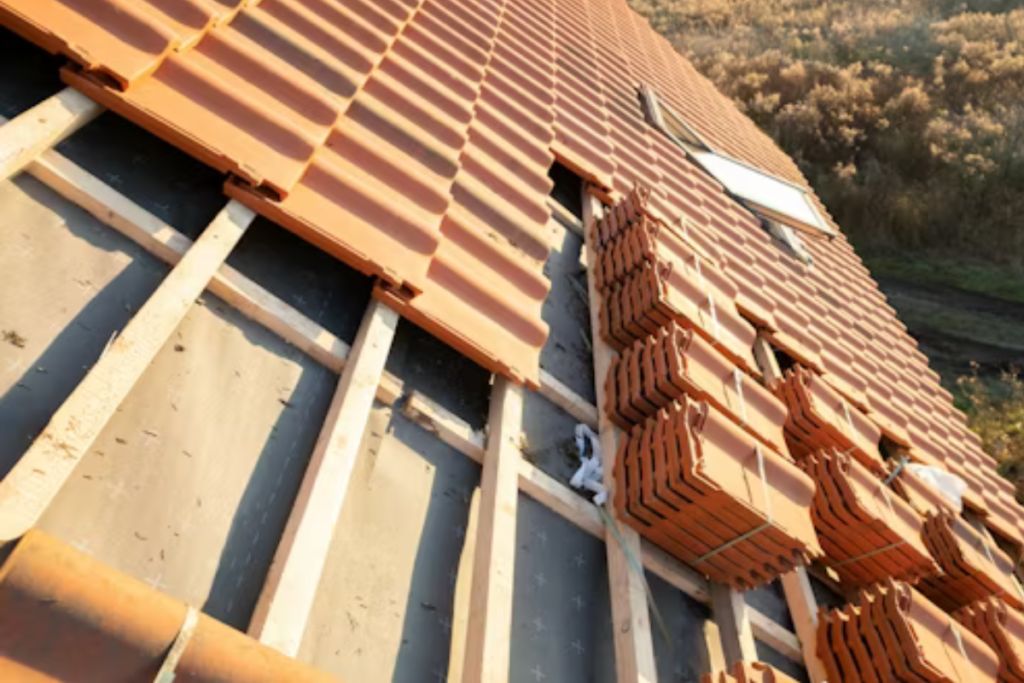
A homeowner on Marion Avenue in Mansfield replaced his roof in 2019. Good-quality GAF Timberline HDZ architectural shingles. Licensed Ohio contractor. Building permit pulled, inspection passed. He thought he was done with roofing for twenty years.
In January 2023, a water stain appeared on the ceiling of his home office. It was small. He ignored it. By March, it had spread to the size of a dinner plate, and a faint, mildewy smell had developed in the room. He called the contractor who installed his roof.
The contractor arrived, inspected, and found the problem within fifteen minutes. Not a shingle failure. Not a manufacturer’s defect. The step flashing at the wall-to-roof junction on the north dormer had been installed incorrectly in 2019. Three pieces of step flashing had been run as a single continuous piece of L-metal rather than as individual overlapping pieces woven with each shingle course. Ohio’s freeze-thaw cycling had worked the continuous piece back and forth for three winters until it separated from the wall, creating a pathway for wind-driven water.
He had a four-year-old roof with a leak caused by flashing installed incorrectly on the first day of the project. The shingles were perfect. The underlayment was dry. The problem was a technique error in the flashing installation that costs nothing to do correctly and everything to leave wrong.
Roof flashing is the single most common hidden cause of roof leaks in Mansfield homes. It accounts for the majority of leak complaints on roofs under 10 years old, and it is responsible for interior water damage that homeowners consistently attribute to shingles, cracks, or roof age when the real cause is sitting at every chimney base, wall junction, valley, and penetration on the roof.
This guide covers every flashing type found on Mansfield homes, how Ohio’s climate specifically attacks each one, how to identify flashing failure from inside and outside the home, and what a correct repair looks like, including the cost ranges you should expect from licensed Richland County roofing contractors in 2026.
What Is Roof Flashing and Why Does It Matter So Much?
Roof flashing is thin metal, typically galvanised steel, aluminium, or copper, installed at every transition point on the roof where two surfaces meet or where the roof surface is penetrated. It is the waterproofing system at every location where shingles alone cannot provide a weather seal.
Think of a residential roof as a series of flat, overlapping surfaces (the shingles) interrupted by obstacles: a chimney rising through the deck, a plumbing vent penetrating the surface, a wall meeting the roof slope at a dormer, and two roof planes meeting at a valley. At every one of those transitions, water flowing down the roof surface must be directed away from the gap that the obstacle creates. Flashing performs that function.
Here is the property that makes flashing both essential and fragile: it must accommodate movement. A chimney expands and contracts thermally at a different rate than the surrounding roof deck. A wall attached to a house moves independently from the roof framing attached to the same wall. Plumbing vents transmit vibration and thermal movement from below. Flashing must seal these transitions while allowing the differential movement between adjoining components, or the seal will eventually fail.
In Ohio’s climate, that movement demand is extreme. Richland County averages 80 to 100 freeze-thaw cycles per year. Each cycle expands and contracts every metal surface, every sealant joint, and every bond between dissimilar materials. A flashing installation that would hold for 25 years in a mild climate may fail within 8 to 12 years in Mansfield’s climate if it lacks the flexibility and mechanical attachment to handle that cycling.
The contractor incentive problem: Here is the behind-the-curtain truth about flashing quality in Mansfield’s roofing market. Flashing materials for an average Mansfield home cost $300 to $600. The difference between cheap galvanised flashing and premium copper flashing is roughly $200 in materials on a typical project. But quality flashing installation takes significantly more time than quick caulk-based alternatives. On a competitive bid, a contractor who cuts flashing quality and installation time can submit an estimate $800 to $1,200 lower than one who does it right. The homeowner cannot see the difference from the ground on bid day. They see it in their ceiling three winters later.
The 8 Types of Roof Flashing on Mansfield Homes and How Each Fails
Every residential roof in Mansfield has multiple flashing types. Understanding each type, its specific failure pattern in Ohio’s climate, and the interior symptom it produces is the foundation for diagnosing any Mansfield roof leak correctly.
Step Flashing (Wall-to-Roof Transitions). Step flashing consists of individual L-shaped metal pieces, typically 8 inches by 8 inches, installed one per shingle course at every junction where a roof slope meets a vertical wall surface: dormers, additions, skylights with raised curbs, and wall-mounted chimneys. Each piece overlaps the piece below and is tucked under the siding above. The critical installation requirement is that each piece be individual and overlapping, not a single continuous piece bent to follow the wall. Ohio contractors who substitute a continuous piece of bent counter-flashing for proper step flashing at wall junctions create exactly the failure pattern found on the Marion Avenue home: a single-piece installation that thermal cycling separates from the wall at its most stressed point.
Chimney Counter-Flashing and Base Flashing. Chimney flashing is the most complex flashing system on most Mansfield homes. It consists of base flashing (sheet metal running up the chimney sides from the deck), step flashing (individual pieces on the sloped sides), saddle or cricket flashing (behind the chimney on wide chimneys), and counter-flashing (metal embedded in the chimney mortar joints and bent down over the base flashing). The counter-flashing is the most common Mansfield chimney leak source because it is embedded in masonry mortar that deteriorates due to Ohio’s freeze-thaw cycling. When the mortar joint behind the counter-flashing fails, water enters behind the metal and runs down the chimney face into the attic.
Chimney Cricket Flashing. A cricket is a small, peaked metal structure installed behind a chimney wider than 30 inches to divert water around the chimney base. Ohio’s building code requires crickets on chimneys of this width. However, crickets are frequently omitted on budget re-roofs because they require additional labour and custom fabrication. A wide chimney without a cricket accumulates debris and standing water at its back face, accelerating flashing failure and creating direct water infiltration paths. If your Mansfield home has a chimney wider than 30 inches and you have experienced leaks behind that chimney, the absence of a properly installed cricket is almost certainly a contributing factor.
Valley Flashing. Valleys are where two roof planes meet at a downward angle, creating a water channel that concentrates runoff. Valley flashing in Mansfield homes uses either open metal (a continuous W-channel or V-channel visible between shingles), closed-cut (shingles from one plane cut to overlap the valley centre with ice and water shield beneath), or woven (shingles from both planes woven through the valley). Metal valley flashing on Mansfield homes from the 1970s through 1990s is frequently galvanised steel that has reached the end of its corrosion resistance. Rust-through is visible as reddish-brown streaking from valley lines on the roof surface and produces interior ceiling stains below the valley line.
Pipe Boot Collars. Every plumbing vent, electrical conduit, and HVAC penetration through the roof deck is sealed with a pipe boot: a metal base flashing with a rubber or neoprene collar that seals around the pipe. The rubber collar is the failure point. UV radiation degrades rubber collars on Ohio roofs within 8 to 12 years. A cracked or separated pipe boot collar is one of the easiest roof leaks to identify (binocular inspection from the ground shows the degraded rubber clearly) and one of the most cost-effective to repair ($150 to $350 per boot for a licensed contractor, or approximately $80 to $150 in materials for a capable DIYer).
Drip Edge Flashing. Drip edge is the L-shaped metal installed at the eave and rake edges of the roof deck to direct water off the edge and away from the fascia. Ohio’s building code requires a drip edge at both eaves and rakes. On Mansfield re-roofs before approximately 2012, the drip edge was commonly installed only at eaves and omitted at rakes. Rake-edge drip edge omission allows wind-driven rain to wick under the shingle edge and into the decking and fascia, producing fascia rot that is not visible until the wood has significantly deteriorated.
Roof Flashing Failure and Repair Reference: Mansfield, Ohio 2026
| Flashing Type | Location | Ohio Failure Rate | Primary Failure Cause | Repair Cost (Mansfield) | DIY Feasible? |
| Step flashing | Wall-to-roof transition | Very high | Missing or inadequate pieces at re-roof | $400–$900 | No — shingle removal req. |
| Chimney counter-flashing | Chimney sides and back | Very high | Mortar joint separation; sealant failure | $600–$1,800 | No — masonry required |
| Chimney cricket flashing | Pipe boot/collar | High | Often omitted entirely on budget jobs | $800–$2,200 | No — structural work |
| Valley flashing | Where two roof planes meet | High | Rust-through; improper overlap laps | $500–$1,200 | No — full-surface work |
| Pipe boot / collar | Plumbing stack penetrations | Very high | Rubber gasket UV degradation (8–12 yrs) | $150–$350 per boot | Moderate — accessible |
| Skylight flashing | Skylight perimeter | High | Sealant failure; improper pan flashing | $600–$1,600 | No — complex geometry |
| Drip edge | Eave and rake perimeter | Medium | Missing at rakes; improper overlap | $300–$700 full perimeter | Moderate — partial access |
| Dormer flashing | Dormer wall-to-roof | High | Step flashing omitted; caulk-only installs | $500–$1,400 | No — multiple components |
How to Find a Flashing Leak in a Mansfield Home: The Diagnostic Process
The most frustrating characteristic of flashing leaks is that the interior water stain rarely appears directly below the roof breach. Water entering at a failed chimney counter-flashing joint may travel 6 to 12 feet along a rafter before dripping through the ceiling. The interior stain that appears near a center of room light fixture may originate at the valley flashing on the opposite side of the ridge.
Here is the diagnostic sequence I recommend to every Mansfield homeowner before calling a contractor, because it makes the contractor conversation significantly more productive and reduces the chance of misdiagnosis.
Step 1 — Attic inspection during or immediately after rain (safest diagnostic). Access the attic during or within 30 minutes after a rain event. Bring a flashlight. The active water entry point will be visible as dripping, streaming, or beading on the underside of the roof deck. Mark the location with chalk or tape, then measure from the nearest ridge or wall to transfer the location to the exterior.
Step 2 — Interior stain location mapping. Identify all interior stain locations. For each stain, note whether it is near an exterior wall, below a valley line, near a chimney or skylight, or in the field of the ceiling away from these features. Use the leak location diagnostic table in this guide to identify the most likely flashing source for each stain pattern.
Step 3 — Ground-level exterior inspection with binoculars. From all four sides of the home, examine every visible flashing location with binoculars. Look for: lifted or separated counter-flashing at chimney faces, rust streaking from valley lines, pipe boot collars that appear cracked or separated, missing or buckled drip edge sections, and any visible gaps between siding and wall-to-roof transition areas.
Step 4 — Hose test if rain is not available. With a helper inside the attic, work systematically up the roof with a garden hose, starting at the suspected leak area. Soak each flashing zone for 2 to 3 minutes before moving up. When the helper reports water entry, you have identified the zone. This test has limitations, but it is far more diagnostic than guessing from interior stain location alone.
Interior Leak Location to Flashing Source Diagnostic Guide
| Where Leak Appears Inside | Most Likely Flashing Source | Confirm By | Urgency |
| Near fireplace or chimney | Chimney counter-flashing or cricket | Check sealant at the frame corners | High — act within weeks |
| Below the skylight in the ceiling | Skylight pan or perimeter flashing | Below the skylight in ceiling | High — skylight frame damage |
| Along interior wall below gable | Step flashing at wall-roof transition | Check each step piece from attic | High — wall framing at risk |
| Near center of ceiling span | Valley flashing rust or improper overlap | Inspect valley from attic in rain | Medium-High |
| Near plumbing stack location | Pipe boot gasket failure | Visual inspection from ground with binoculars | Medium — worsens quickly |
| At eave edge or soffit | Drip edge omission or ice dam backup | Check for missing rake drip edge | Medium — seasonal |
| Scattered stains, no pattern | Multiple flashing failures or diffuse | Full attic inspection required | High — widespread damage |
Why Ohio’s Freeze-Thaw Cycle Is the Enemy of Every Flashing Joint
Mansfield averages 80 to 100 freeze-thaw cycles per year. Each cycle is a mechanical stress event for every flashing joint on the roof. The physics are straightforward: water expands approximately 9 percent when it freezes. Any water present in a flashing joint, a mortar crack behind counter-flashing, a gap in a sealant bead, or a pinhole in a pipe boot collar expands when it freezes and drives the gap wider. When it thaws, the gap is marginally larger than before the cycle. Over 80 cycles in a single Ohio winter, a marginal gap becomes a functional water pathway.
This is why flashing failures in Mansfield tend to accelerate rather than develop linearly. A flashing joint that performs adequately for eight winters may fail dramatically in the ninth, because the cumulative effect of freeze-thaw cycling has finally opened the gap to the point where rain events produce measurable water entry. The homeowner experiences this as a roof that suddenly started leaking, when in fact the joint has been deteriorating progressively for years.
The flashing materials most resistant to Ohio’s freeze-thaw cycling are copper (soft enough to accommodate movement without cracking, corrosion-resistant for 50 to 100 years) and aluminium (lighter than copper, corrosion-resistant, adequate for 20 to 30 years in Ohio conditions). Standard galvanised steel flashing is the most commonly installed product in Mansfield and has the shortest functional lifespan in Ohio’s climate: 15 to 25 years before corrosion becomes a significant factor, less in areas with direct ice dam contact.
The sealant selection problem: Most flashing sealant failures in Ohio are not material failures. They are product selection failures. Elastomeric roofing cement (products like Henry Wet Patch, Gardner-Gibson, or Karnak 220) remains flexible through Ohio’s temperature range and accommodates the movement that flashing joints experience. Standard silicone caulk loses flexibility below freezing and becomes brittle within three to five Ohio winters. I have seen Mansfield roofs where every visible flashing joint was caulked with standard home-improvement silicone, and every joint was cracked and open after five winters. The product cost difference is negligible. The outcome difference is a decade of service life.
How to Fix Roof Flashing Leaks in Mansfield: Repair vs. Replace
The honest answer to whether flashing repair or replacement is appropriate depends entirely on the specific flashing type, the material’s remaining service life, and the access required to perform the repair correctly.
Pipe boot replacement is the most appropriate DIY flashing repair for confident Mansfield homeowners. Universal pipe boot replacement kits from Perma-Boot, Dektite, or LM Quadrant install over existing failed boots without requiring shingle removal on most standard installations. These products carry 25-year warranties and correct the most common pipe boot failure mode with approximately 30 to 60 minutes of work per penetration.
Valley flashing replacement is not a DIY project on most Mansfield homes. Replacing valley flashing requires removing the shingles on both adjacent roof planes, installing new ice and water shield, installing new valley metal with appropriate overlap and sealing, and reinstalling shingles. On a typical Mansfield valley, this represents 4 to 8 hours of skilled labour. Attempting this work without proper shingle removal techniques damages surrounding shingles, creating additional leak pathways.
Chimney flashing repair is a judgment call that depends on the material condition of the existing counter-flashing. If the counter-flashing metal is sound but the mortar joint behind it has separated, a licensed Mansfield roofer can tuck-point the mortar joint and reseal the counter-flashing edge with elastomeric sealant for $200 to $500. If the counter-flashing metal has corroded through or was improperly installed (insufficient height up the chimney face, improper overlap geometry), full counter-flashing replacement at $600 to $1,800 is the correct repair.
The re-roof flashing replacement standard: My strong opinion is that every licensed roofing contractor performing a complete re-roof in Mansfield should replace all flashing as part of the standard scope, not as an add-on. Reusing 15-year-old galvanised steel flashing under a new 30-year architectural shingle installation is the leading cause of new-roof leak complaints within the first 5 years. If a Mansfield contractor’s re-roof estimate retains existing flashing, ask specifically why and request a line-item cost to replace it. The difference is typically $600 to $1,200 on an average project. On a $16,000 re-roof, that investment prevents the most common post-installation leak complaint.
Frequently Asked Questions: Roof Flashing and Leaks in Mansfield Homes
Why is my roof leaking in Mansfield, Ohio, if it was recently replaced?
The most common cause of leaks on recently replaced Mansfield roofs is incorrect or retained flashing. Specifically: step flashing at dormers or wall junctions installed as a single continuous piece rather than individual overlapping pieces, existing chimney counter-flashing retained from the previous roof rather than replaced, and pipe boot collars not replaced at re-roof. Each of these failures can produce interior water staining within the first three to five winters after installation. A new roof with incorrect flashing will leak. The shingles are not the problem.
What are the signs of damaged roof flashing in Mansfield?
Signs of flashing failure visible from the ground include: rust-orange streaking from valley lines on the roof surface, separated or lifted metal edges at chimney faces or base, pipe boot collars that appear cracked or deformed when viewed with binoculars, gaps between siding and wall-to-roof transition areas, and granule staining in gutters below flashing locations. Interior signs include ceiling stains near chimneys, skylights, dormers, or plumbing stack locations, and a musty odour in rooms with exterior wall adjacency.
How much does roof flashing repair cost in Mansfield, Ohio?
Flashing repair costs in Mansfield as of early 2026 range widely by type: pipe boot replacement runs $150 to $350 per penetration; chimney counter-flashing resealing runs $200 to $500; full chimney flashing replacement runs $600 to $1,800; step flashing replacement at a dormer or wall runs $400 to $900; valley flashing replacement runs $500 to $1,200; full-roof drip edge replacement runs $300 to $700. Emergency leak tarping runs $300 to $600 and is typically charged separately from the permanent repair.
Can I fix roof flashing myself in Ohio?
Pipe boot replacement is a feasible DIY repair for confident homeowners comfortable on a roof, using products like Perma-Boot or Dektite that install without shingle removal. Drip edge replacement at accessible eave sections is also a moderate DIY task. Step flashing replacement, chimney flashing repair, and valley flashing replacement require shingle removal, precise metal fabrication or fitting, and correct sealant application that most homeowners cannot perform to the standard required for Ohio’s climate. Incorrect DIY flashing repair frequently creates additional leak pathways and can void roofing warranties.
How long does roof flashing last in Ohio?
Flashing material lifespan in Ohio’s freeze-thaw climate: copper flashing lasts 50 to 100 years and is the gold standard; aluminium flashing lasts 20 to 30 years; galvanised steel flashing lasts 15 to 25 years before corrosion becomes significant; rubber pipe boot collars last 8 to 12 years before UV degradation creates cracks. Lead flashing (found on older Mansfield homes) lasts 50 to 100 years but is rarely installed today due to material cost and handling regulations. The sealant at every flashing joint typically requires inspection and re-application every 5 to 8 years in Ohio conditions.
Should roof flashing be replaced when I get a new roof in Mansfield?
Yes, in almost every case. Reusing existing galvanised steel flashing under a new architectural shingle installation is the leading cause of early leak complaints on Mansfield re-roofs. A new 30-year shingle installation should not rely on 15-year-old flashing components. The additional cost to replace all flashing at re-roof time in Mansfield runs $600 to $1,200, depending on roof complexity. This investment prevents the most common post-installation failure mode and is significantly less expensive than the post-installation leak repair and interior damage remediation it prevents.
What type of flashing is best for Ohio homes?
Copper is the highest-performance flashing material for Ohio’s climate: indefinite corrosion resistance, excellent thermal flexibility, and compatibility with most roofing materials. The cost premium (approximately 3 to 5 times the cost of galvanised steel) is justified on high-value Mansfield homes and at chimney and skylight locations where failure consequences are highest. For standard Mansfield residential applications, aluminium is the best value choice: adequate corrosion resistance, good thermal flexibility, and significantly longer Ohio service life than galvanised steel. Avoid galvanised steel at chimney and valley locations where ice dam contact accelerates corrosion.
Why does my roof only leak in certain weather conditions?
Flashing failures often produce intermittent leaks because the failure pathway requires specific conditions to admit water. Wind-driven rain enters a failed step flashing joint at wall junctions only when wind pushes water horizontally against the wall. A separated chimney counter-flashing joint may only leak when rain falls on that specific chimney face. A failed valley flashing section may only leak when heavy rainfall volume exceeds what the damaged area can redirect. Intermittent leaks that correlate with wind direction, heavy rainfall, or specific winter conditions almost always indicate flashing failure rather than shingle failure.
The Flashing Inspection That Changes Everything
The Marion Avenue homeowner had his step flashing corrected in March 2023. The contractor removed the dormer shingles, installed individual overlapping step flashing pieces woven correctly with each shingle course, and reinstalled the shingles with a new starter course at the wall base. The repair took four hours and cost $780. His 2019 roof has not leaked since.
He told me afterwards that he wished someone had explained flashing to him before he hired his original roofer. He would have asked different questions during the estimate process. He would have asked to see how the step flashing would be installed. He would have been suspicious of an estimate that made no specific mention of a flashing scope.
Roof flashing is not glamorous. It does not feature in roofing advertisements. It is not what homeowners think about when they evaluate shingle grades or warranty tiers. But it is the single most common hidden cause of roof leaks in Mansfield homes, and understanding it is the difference between a roof that performs as promised and one that produces water stains while still under warranty.
Your Mansfield roof has chimney flashing, step flashing, pipe boots, valley flashing, and drip edge. When you last had a roofing contractor on your property, did they inspect or discuss any of these? If not, schedule a flashing inspection this season. It is the roof maintenance step that prevents the most expensive problems.
Has a flashing failure caused a roof leak in your Mansfield home? Where was the failure, how long before you found it, and what did the repair cost? Leave your experience in the comments below.
All pricing reflects Mansfield, Ohio and Richland County contractor market rates as of early 2026. Individual repair costs vary by roof complexity, access difficulty, and flashing material selection. Obtain written estimates from licensed Ohio HIC-registered roofing contractors for accurate project pricing.